

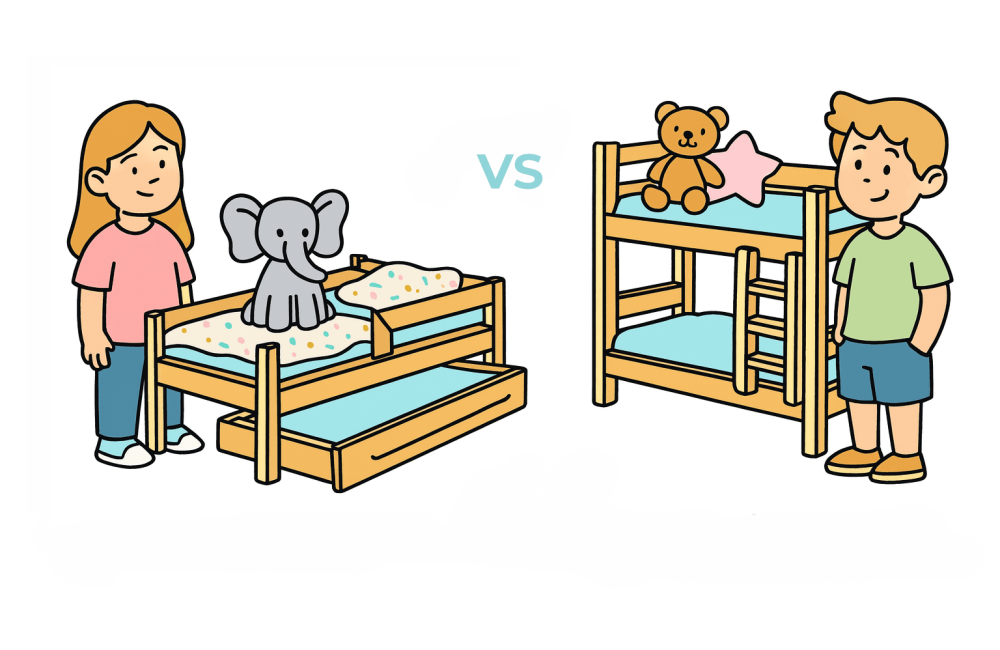
When two children share a room or friends often come for sleepovers, parents face an important question: Should we choose a trundle bed or a classic bunk bed? Both models save space and offer two sleeping spots – but they differ in safety, flexibility, and everyday practicality.
In this article, we highlight the advantages of both options, present different designs, and help you find the best solution for your family.
The Bunk Bed – Saving Space in Height
A bunk bed is a classic choice for siblings sharing a room. Two fixed sleeping areas are arranged on top of each other, saving valuable floor space.
Children love the adventurous character of sleeping “up high,” while parents appreciate the compact solution that offers two permanent beds in even small rooms.
However, parents should keep in mind that the top bunk is recommended only from around 6 years of age, as climbing and sleeping at height comes with an increased risk of accidents for younger kids.
The Trundle Bed – Flexible and Safe
A trundle bed also provides two sleeping areas, but on the same level. The second mattress is hidden under the main bed and can be pulled out whenever needed.
Key advantages include:
safe and low to the ground – suitable even for toddlers,
perfect for siblings or sleepovers,
space-saving – the second bed is used only when needed,
often includes safety rails for peaceful nights.
👉 Trundle bed with safety rails – natural »
Different Designs of Trundle Beds
A trundle bed isn’t always the same – there are different styles to match your child’s room and your family’s preferences.
Classic trundle bed: simple, practical, and timeless. Ideal for families looking for a minimalist, space-saving solution.
House bed with trundle (symmetrical or asymmetrical): combines the practicality of a trundle bed with the playful charm of a house bed. The roof-shaped frame turns it into the highlight of the children’s room – perfect for playing, reading, and sleeping – while still offering two full sleeping areas.
👉 House bed with trundle simetrical
👉 House bed with trundle asimetrical
This way, parents can choose between a classic and understated design, or a creative and playful option. Both are made from solid wood, built to European standards, and completely safe for children.
Trundle Bed vs. Bunk Bed – Which Fits Better?
Both solutions create two sleeping spots in a small space – but the differences matter:
Child’s age: trundle beds are suitable even for young children, while bunk beds are recommended from about 6 years.
Safety: no climbing with a trundle bed, climbing required with a bunk bed.
Room layout: bunk beds save vertical space, trundle beds save floor space when not in use.
Flexibility: trundle beds are perfect for guests or occasional use, bunk beds are a permanent solution for siblings.
Conclusion
Whether you choose a trundle bed or a bunk bed – both are practical, space-saving solutions for families.
For younger children or families who often host sleepovers, a trundle bed is the safest and most flexible choice.
For older siblings sharing a room, a bunk bed offers both functionality and a sense of adventure.
🛒 Discover our full collection of trundle beds and bunk beds, crafted from solid wood in Europe and tested to EU safety standards:
👉 See all children’s beds »
📚 Sources
Federal Centre for Health Education (BZgA): Recommendations on children’s sleep
Maria Montessori: The Discovery of the Child (1909)
Association Montessori Internationale (AMI): Introduction to Montessori education
Experiences of parents & customers of Need Sleep